
A study desk in warm window light: an open laptop showing the OmniTaught EMS Operations Prep for EMTs course, a mug of coffee, an open notebook with a fountain pen, and reading glasses
A hand holding a phone running the OmniTaught app, at a sunlit table with a mug of coffee and a notebook
OmniTaught ๐Ÿ”ฅ 6Topics

Course

EMS Operations Prep for EMTs

4 of 6 lessons complete

โœ“ Air medical and rescue: helicopters, landing zones and wrecked cars
When to ask for the aircraft, setting a landing zone, and your role at an extrication ยท 7 min
100%
6 The record and the team: reports, handoffs, safety and your own mind
The patient care report, radio report and handoff, crew resource management, and 988 ยท 7 min
7 EMS Operations Timed Set
25 items, 30 minutes, exam mode ยท 30 min

Lesson 5

Hazardous materials, terrorism and disaster: do not become a patient

On most calls, getting to the patient fast is the right instinct. At a hazardous materials scene that instinct is what hurts responders. A rescuer who collapses beside the patient has helped nobody and has just given the next crew two people to reach. Your first job is to recognize the scene for what it is while you are still outside it.

  • The place: a tanker truck, a rail car, a factory, a farm chemical store, a pool supply room, a laboratory.
  • Diamond-shaped placards on vehicles and labels on containers, each with a four-digit identification number. The Emergency Response Guidebook turns that number into a first isolation distance and the main dangers. Shipping papers ride in the truck's cab or with the train crew.
  • A vapor cloud, a strange smell, a hissing sound, spilled liquid or powder.
  • Several people with the same complaint at the same time, with no injury to explain it. Dead birds, fish or insects.
  • The dispatch itself: an explosion, "unknown odor", "multiple people down".

Read placards with binoculars, not by walking up to them.

Quiz now, while it is fresh. 8 questions, no timer.

1 of 8

You are sent to a warehouse for "several people sick". From the street you see four workers lying near an open bay door and two more stumbling out, all coughing. A hissing sound comes from inside. What do you do FIRST?

The question on the screen is a real one

EMS Operations Prep
for EMTs

6 lessons, 72 practice questions, 36 flashcards, and 1 timed exam set. Other First Responder Courses.

Other First Responder Courses

Built the same way, and every one of them is included.

And if the thing you need is not on the shelf at all, the Topic Genie builds a full course on anything you name, with the same lessons, questions and review schedule as this one.

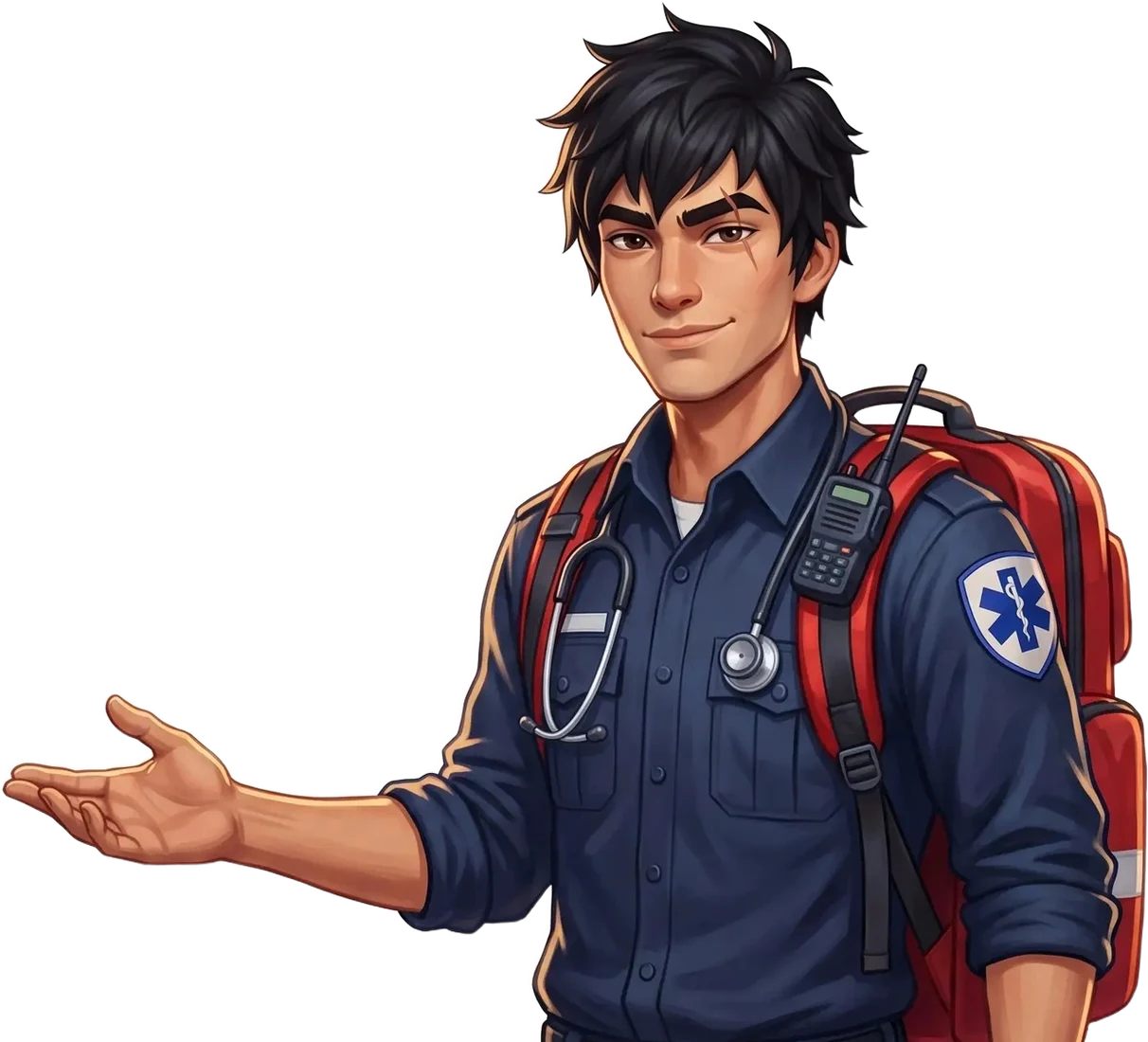
An EMT in a navy uniform with a red jump bag on his back, smiling, holding out an open hand toward the courses

Who builds this

Built by a teacher who became a National Certified Counselor.

OmniTaught is developed by Michael C. Shedrick, M.S., PLPC, NCC: a teacher with a master's degree in educational leadership who went on to become a National Certified Counselor. Both jobs kept exposing the same problem: learning tools that stop at definitions. So this course teaches the working version of its subject, the part you actually use when the real thing is in front of you, and it teaches it the way memory works: a short lesson, a quiz while it is still fresh, and review that brings it back before you lose it.

Also from the same desk, in case they are useful: OmniPsyche Counseling Tools, which preps your next session and not just your notes; OmniPsyche.org, free mental health education with no paywall and no signup; and NOTICE, a free guided meditation app.

What this course covers

Every lesson is short enough to finish in one sitting and ends with questions that make you use what you just read. The last ones are timed, in exam conditions.

  1. Ambulance operations: getting there and back in one pieceDue regard, intersections, backing, securing people and gear, and driving tired7 min
  2. Incident management: where the EMT fits in the command systemOne commander, one boss each, staging, plain language, and unified command7 min
  3. Multiple-casualty incidents: sorting patients when there are too manyDeclaring it early, START and JumpSTART, tags, treatment areas, and re-triage7 min
  4. Air medical and rescue: helicopters, landing zones and wrecked carsWhen to ask for the aircraft, setting a landing zone, and your role at an extrication7 min
  5. Hazardous materials, terrorism and disaster: do not become a patientRecognizing a hazmat scene, the three zones, decontamination, and nerve agent signs7 min
  6. The record and the team: reports, handoffs, safety and your own mindThe patient care report, radio report and handoff, crew resource management, and 9887 min
Show all 7 lessonsShow fewer
  1. EMS Operations Timed Set25 items, 30 minutes, exam mode30 min

A whole lesson, start to finish

Not a sample and not a summary. This is all of lesson 2, exactly as it reads in the app, and then one of the 8 questions that follow it.

Lesson 2 of 7 · about 7 min

Incident management: where the EMT fits in the command system

One commander, one boss each, staging, plain language, and unified command

A two-car crash with one patient needs no organization chart. A bus rollover, an apartment fire or a tornado does. When many crews from many agencies arrive at one scene, somebody has to decide who does what, or everybody does the same thing and the rest goes undone. The incident command system (ICS) is the standard answer in the United States. It is part of the National Incident Management System.

The rules that make it work

  • One incident commander. One person is in charge of the whole incident. On a small call that person may also be doing patient care. On a large one they do nothing but command.
  • Unity of command. Every responder reports to one supervisor and takes assignments from that one person.
  • Span of control. One supervisor can manage roughly three to seven people, with five as the usual target. Past that, the job is split.
  • Plain language. No ten-codes and no agency slang on the radio. Crews from other towns do not share your codes.
  • It grows and shrinks. Only the positions the incident needs are filled.
  • Accountability. Command knows who is on scene, where they are and what they are doing.

If you are first on scene

The first unit to arrive is in command until someone takes it over. If that is your ambulance, do not dive into the first patient you see. Do these things instead:

  1. Stop where you can see the scene and are out of danger.
  2. Give a short size-up on the radio: what you see, about how many patients, and what hazards.
  3. Say that you are establishing command, and name it, for example "Main Street Command".
  4. Ask for the help you think you will need, and say where you want it to stage.
  5. Start triage, or assign your partner to it.

When a supervisor or chief officer arrives, command is transferred face to face if at all possible, with a short briefing: what happened, what has been done, who is assigned where, and what is still needed. Then it is announced on the radio so everyone knows who is in charge now.

Staging, and why you wait there

Staging is a named place, away from the scene, where arriving units park and wait for an assignment. When you are sent to a working incident, you go to staging, check in with the staging officer, and wait there for an assignment. You do not drive to the scene because you can see where the work is. That is called freelancing. A freelancing crew creates confusion and safety problems for everyone else working the scene.

The EMS side of the chart

On a large medical incident, command usually sets up a medical group or EMS branch. Under it are the jobs you are most likely to be handed: triage (sort the patients), treatment (care for them in the treatment area), and transport (load them, track them and spread them among hospitals). A safety officer watches for hazards and can stop any unsafe action on the spot. Whatever your assignment, you report to the person who gave it to you, you finish it, and you report back for the next one.

Unified command

Some incidents belong to more than one agency at once. A shooting is a police scene and an EMS scene. A chemical spill on a highway belongs to fire, police, EMS and perhaps the state. In unified command, the leaders of the agencies with responsibility stand together at one command post and agree on one set of objectives and one plan. Each still directs their own people. Crews on the ground still have one supervisor each, and they hear one plan instead of three.

The thing to remember

Check in, take one assignment from one supervisor, do it, and report back. If you are first in, size up, name command and call for help before you touch a patient.

Stay grounded

Position titles, vest colors, radio channels and staging procedures differ between regions. Your local incident plans, your protocols and your medical director govern real practice. FEMA's online independent study courses on ICS are the usual formal training, and your agency will tell you which ones it requires.

Your ambulance is the first unit to arrive at a church van rollover with about ten people on the ground, several of them crying out. What do you do FIRST?

Where this comes from

OmniTaught is an independent study app and does not represent the National Registry of EMTs, any government agency or any EMS authority. This course is study material: it is not continuing education credit and does not count toward recertification. On real calls your local protocols and medical director come first. If you or a colleague are in crisis, call or text 988, the Suicide and Crisis Lifeline.

Official sources: National EMS Scope of Practice Model (PDF) · SAMHSA, the 988 Lifeline

Questions people ask

Is there an app for EMTs to study EMS operations?

Yes. OmniTaught opens in any browser and installs to a phone or a computer like an app, and it works offline once you have opened it. EMS Operations Prep for EMTs is 6 lessons, 72 practice questions and 36 flashcards, and the first week is free with no card.

What does EMS Operations Prep for EMTs cover?

Driving, command, triage, aircraft, rescue, hazmat, and the paperwork. It is 6 lessons long, plus 1 timed exam set in exam conditions, and every lesson ends with questions on what you just read.

How long is each lesson?

About 7 minutes. There are 6 of them, so the reading comes to about 42 minutes in total, and it is built to be done a lesson at a time rather than in one sitting.

How much practice is in it?

72 practice questions, every one with an explanation of why the right answer is right, plus 36 flashcards that come back on a schedule built from how well you knew them last time.

What does it cost?

Nothing for the first week, and no card is asked for. After that OmniTaught is $9.99 a month or $79 a year, which opens every course on the site, this one included, plus one Genie course a month.

Free for a week. Then $9.99 a month.

No card to start.

EVERYTHING INCLUDED
$9.99a month, or $79 a year
  • Every course in the ever-growing library, every quiz, & your review deck.
  • One Genie course a month, built on whatever you name. Extra courses are $6.99 each. Add narration to any Genie made course for $9.99.
  • A free week first, no card needed. Cancel any time from Settings.
Start EMS Operations Prep for EMTs free

Flashcard apps have the science but no content. Content sites have no retention engineering. This one has both, built one craft at a time.