Example: I want to understand statistics well enough to read research papers without getting lost.
What do you already know?
Be honest, zero judgment. Example: I passed a stats class ten years ago and remember almost nothing.
Where will you use it?
Example: I am an emergency medical responder and want to understand the medicines my patients take at home.
Your wishes
✦ You have 1 wish. Granting a course spends one.
OmniTaughtA
Lv 1Lv 270 XP to go
EMR Exam Prep · Lesson 1 of 18 · 8 min
What an Emergency Medical Responder is, the system you work inside, and the law that holds you
Your role, the levels above you, medical direction, scope, consent, and negligence.
0:00 / 8:00
1x1.25x1.5x
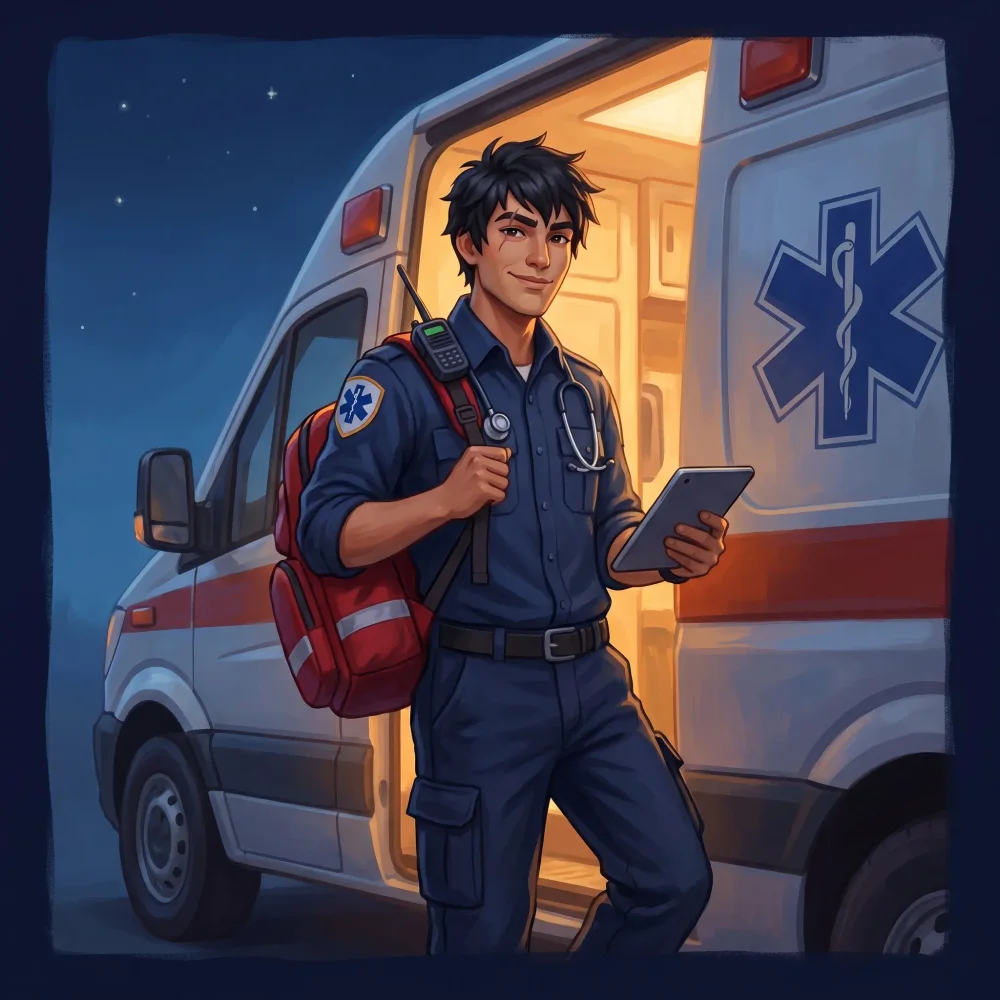
When you are the first trained person on scene, before an ambulance arrives, you are an Emergency Medical Responder, or EMR. Your job is to start the lifesaving care a patient needs right now and keep the emergency system moving toward that patient. You are not working alone even when you feel alone: higher-level clinicians, dispatchers, and a physician overseeing the whole operation stand behind every call. This lesson lays out that system, who directs your practice, and the legal ground you stand on the moment you touch a patient.
About the certification examThe Registry's EMR exam runs 1 hour and 45 minutes, a minimum of 90 items and a maximum of 110, including 30 unscored items used to test future questions and never counted against you. It is computer adaptive. Primary Assessment is the largest share, 37 to 41 percent. Scene Size-up and Safety is 19 to 23 percent, Patient Treatment and Transport is 20 to 24 percent, Operations is 10 to 14 percent, and Secondary Assessment is 4 to 8 percent.
The EMS system you work inside
EMS is built in tiers, and each one is licensed to do more than the one before it. The agency that sets the national model recognizes four levels of care: Emergency Medical Responder, Emergency Medical Technician, Advanced EMT, and Paramedic. As an EMR you are usually the first of these levels on scene, often a firefighter, police officer, lifeguard, or other cross-trained responder whose main job is not EMS. Your role is to hold the line until a higher level arrives, not to provide every treatment a patient might eventually need.
Quiz now, while it is fresh. 8 questions, no timer.
OmniTaughtA
What an Emergency Medical Responder is, the system you work inside, and the law that holds you
The one thing worth keeping
Your most valuable takeaway · +30 XP
What is the single most valuable thing you take from this lesson? One sentence is plenty.
The most valuable thing here is...
One sentence earns you 30 XP, the moment you save it. It goes into your notes for this lesson too.
OmniTaughtA
←1/8
OmniTaughtA
Lv 1Lv 270 XP to go
Congrats, perfect!
EMR Exam Prep · What an Emergency Medical Responder is, the system you work inside, and the law that holds you
100%
+75 XP · first pass
Nothing missed. Six flashcards joined your review deck.
Level up
You've just reached Level 2!
Student
115 XP
Your story · chapter 2
The town is gone behind the trees and the map is already wrong. You correct it as you walk, boots in muck to the ankle, ink going everywhere.
On this rung · 2 rewards
New card back
Summitfor your review deck
New card back
Northern Lightsfor your review deck
Next · Level 3 Reader
135 XP to go
OmniTaughtA
For first responders
More on the first responder shelf
💉AEMT Exam Prep20 lessons · For First Responders
⚕Paramedic Exam Prep21 lessons · For First Responders
RxMedical Terminology12 lessons · For First Responders
🚑EMT Exam Prep28 lessons · For First Responders
🫁Airway and Ventilation Prep for EMTs6 lessons · For First Responders
Every course here is included. One account, the whole shelf.
You would be amazed what you could learn in six months with just ten minutes a day.
How it works
827practice questions
1timed exam set
Create a custom course, or pick from our library.
OmniTaught5 day streakA
Lv 9Lv 101,200 XP to go
Topics
Pick as many as you like. Each one is built the same way: short lessons, drills, and review that remembers what you forget.
Topic Genie ✦MAKE ONE
Not in the library? Wish for it and the Genie builds the course: lessons, quizzes, flashcards
Short lessons.
OmniTaught5 day streakA
Lv 9Lv 101,200 XP to go
EMR Exam Prep · Lesson 1 of 18 · 8 min
What an Emergency Medical Responder is, the system you work inside, and the law that holds you
Your role, the levels above you, medical direction, scope, consent, and negligence.
0:00 / 6:25
When you are the first trained person on scene, before an ambulance arrives, you are an Emergency Medical Responder, or EMR. Your job is to start the lifesaving care a patient needs right now and keep the emergency system moving toward that patient. You are not working alone even when you feel alone: higher-level clinicians, dispatchers, and a physician overseeing the whole operation stand behind every call. This lesson lays out that system, who directs your practice, and the legal ground you stand on the moment you touch a patient.
What this course is not
OmniTaught is not accredited by CAPCE and is not approved by any state EMS office. These lessons are study material. They do not count as continuing education hours and do not count toward NREMT recertification. Use this course to learn the material well, and get your certification hours from an approved provider.
About the certification exam
The Registry's EMR exam runs 1 hour and 45 minutes, a minimum of 90 items and a maximum of 110, including 30 unscored items used to test future questions and never counted against you. It is computer adaptive. Primary Assessment is the largest share, 37 to 41 percent. Scene Size-up and Safety is 19 to 23 percent, Patient Treatment and Transport is 20 to 24 percent, Operations is 10 to 14 percent, and Secondary Assessment is 4 to 8 percent.
The EMS system you work inside
EMS is built in tiers, and each one is licensed to do more than the one before it. The agency that sets the national model recognizes four levels of care: Emergency Medical Responder, Emergency Medical Technician, Advanced EMT, and Paramedic. As an EMR you are usually the first of these levels on scene, often a firefighter, police officer, lifeguard, or other cross-trained responder whose main job is not EMS. Your role is to hold the line until a higher level arrives, not to provide every treatment a patient might eventually need.
Emergency Medical Responder: starts lifesaving care and holds the patient until more help arrives.
Emergency Medical Technician: the ambulance-level provider who takes over care for transport.
Advanced EMT: EMT skills plus some intravenous access and medication skills.
Paramedic: the widest scope in the field, with advanced airway and medication skills.
Medical direction: online and offline
Every call happens under the authority of a physician, your EMS medical director, even when that physician is not standing next to you. Offline medical direction is the protocol the medical director already approved before you got the call. Online medical direction is a live conversation, usually by phone or radio, where a physician gives you an order in the moment. Both are medical direction; one is written ahead of time, the other happens on the scene, but neither is optional.
Scope of practice: what you may do, and who decides
Scope of practice is the list of duties the law and your certification allow you to perform. It is not standard of care, which is how well you are expected to perform the skills you are allowed to do; a court decides whether you met that standard in a given case. Your state can expand or narrow the national model for any level, so the true floor under your feet is set locally too. Doing something outside your scope is a different problem than doing something inside it poorly, and both can end a career.
Consent: the patient's right to say yes or no
You may not touch a patient without permission. An alert patient gives you expressed consent out loud. When a patient cannot answer you, unconscious, badly injured, or too confused to speak, the law assumes they would want emergency care and lets you proceed under implied consent. A minor cannot give their own consent; a guardian gives it for them, though a responsible adult standing in for that guardian, a teacher or a coach, can consent until the guardian arrives.
A patient who is awake, thinking clearly, and understands the risk of refusing care has the right to refuse it, even care that could save their life. Your job is to show they have that understanding, called capacity, and document exactly what you told them and what they said back. Walking away from a patient who still needs care, once you have already started, is abandonment, and the law can treat it as seriously as never having responded at all.
Remember
Protect yourself first, your partner second, and the patient third, because a hurt responder cannot help anyone. Every patient you can talk to gets to say yes or no to your care, and every patient you cannot talk to is treated as if they would say yes to being saved.
Duty, negligence, and the record you leave
Negligence is not about intent; it can be a simple mistake. A patient claiming negligence must show you owed them a duty of care, that you failed to meet it, and that the failure caused harm. Once you make contact and start care, that duty exists, whether written, spoken, or simply implied by the fact that you started. Most states have a Good Samaritan law protecting a responder acting in good faith at the scene of an emergency. None of that replaces a good patient care report: what you write down is often the strongest evidence of what happened. What a patient tells you is also protected by federal privacy law, with narrow exceptions such as a duty to report suspected abuse of a child or an older adult.
Stay grounded
This lesson teaches the system and the law in general terms. Your own state's statutes, your agency's protocols, and your medical director's direction are what actually govern a call, and they come first.
Quizzes tell your brain this is important.
OmniTaught5 day streakA
Lv 9Lv 101,200 XP to go
Review, timed for just before you would forget.
OmniTaught5 day streakA
Lv 9Lv 101,200 XP to go
Recalling from memory is what makes learning stick, so OmniTaught has you do it three ways: write the key idea in your own words, answer a quiz while the lesson is fresh, and review it just before you would forget.Sources: 2025 American Heart Association Guidelines for CPR and Emergency Cardiovascular Care; 2021 National Guideline for the Field Triage of Injured Patients; 2019 National EMS Scope of Practice Model; NASEMSO National Model EMS Clinical Guidelines; 2021 National EMS Education Standards, with NHTSA's instructional guidelines; National Registry of EMTs test plan for the EMR examination; StatPearls, National Institutes of Health.
First responder topics, and much more
Start with the shelf built for first responders, then search for anything else. If it is missing, the Topic Genie builds it, and then everyone has it.
Try "I want to help clients with panic", "pass my nursing boards", or "stop being bad at percentages".
Topic Genie
Wish for a topic. Watch it become a course.
Tell the Genie what you want to learn, what you already know, and what it is for. It writes a custom course tailored to you, with lessons, quizzes, and reviews.
One free course for signing up.
Every granted wish goes in the Wish Library, a growing collection of learner-made courses that anyone can add to their app for free. One person's wish becomes everyone's course.
Built by a teacher who became a National Certified Counselor.
OmniTaught is built by Michael C. Shedrick, M.S., PLPC, NCC: a teacher with a master's in educational leadership who became a National Certified Counselor. He built the learning app the research says should exist. Lessons stay short, because attention fades fast. A quiz follows at once, because pulling an idea back out of your own head is what makes it stay, not reading it twice. And review comes just before you would forget, when the effort of remembering does the most good.
Also from the same desk: OmniPsyche Counseling Tools, which preps your next session and not just your notes; OmniPsyche.org, free mental health education with no paywall and no signup; and NOTICE, a free guided meditation app.
Be the one who knows their stuff.
Ten minutes a day. Start with the topic your work depends on, or the one that has bugged you since school.
Choose your hero and watch them level up as you learn.
Seven heroes, twenty-five levels, and a story told a chapter at a time. Advance your hero's quest with every completed lesson and find loot at every new level.
Mage
Warrior
Scholar
Druid
Rogue
Bard
Paladin
Free for a week. Then $9.99 a month.
No card to start.
EVERYTHING INCLUDED
$9.99a month, or $79 a year
Every course in the ever-growing library, every quiz, & your review deck.
One Genie course a month, built on whatever you name. Extra courses are $6.99 each. Add narration to any Genie made course for $9.99.
A free week first, no card needed. Cancel any time from Settings.


 Lv 1Lv 270 XP to go



 Lv 9
Lv 9 Lv 9
Lv 9 Lv 9
Lv 9 Lv 9
Lv 9


 Mage
Mage Warrior
 Druid
Druid Rogue
Rogue Bard
Bard Paladin