Topics Β· Premium
Wish for a topic. Any topic.
β¦ You have 1 wish. Granting a course spends one.

Lv 1Lv 270 XP to goAEMT Exam Prep Β· Lesson 1 of 20 Β· 8 min
The scope step up from EMT, who has to authorize it, and how the exam is built.
You are about to spend real time getting ready for the AEMT exam, and it helps to start with what the letters actually mean for your hands and your license. An AEMT carries more tools than an EMT: an IV line, a needle into bone when a vein will not cooperate, a supraglottic airway when a mask is not enough, and a short list of medications you give yourself rather than only assist a patient with. None of that makes you a paramedic. The next four lessons in this part walk through the skills themselves. This one lays out what the level adds, who has to say yes before you can use it, and how the exam itself is built.
The national description of the level is specific about the size of the step up. An AEMT performs focused advanced skills and pharmacological interventions engineered to mitigate specific life threatening conditions, and that is a narrower promise than a paramedic's wide range of tools. The preparation beyond EMT exists because reasonably safe, evidence based interventions are available for common emergencies, not because an AEMT is meant to do everything a paramedic does. In a system with no paramedic coverage, an AEMT may be the most trained person who reaches the patient before the hospital does, which is exactly why the added skills matter and exactly why they stay limited.
Quiz now, while it is fresh. 8 questions, no timer.
What the AEMT adds, the law, and clinical judgment as the exam tests it
Your most valuable takeaway Β· +30 XP
What is the single most valuable thing you take from this lesson? One sentence is plenty.
One sentence earns you 30 XP, the moment you save it. It goes into your notes for this lesson too.
Lv 1Lv 270 XP to goAEMT Exam Prep Β· What the AEMT adds, the law, and clinical judgment as the exam tests it
Nothing missed. Six flashcards joined your review deck.

Level up
You've just reached Level 2!
Student
115 XP
Your story Β· chapter 2
The town is gone behind the trees and the map is already wrong. You correct it as you walk, boots in muck to the ankle, ink going everywhere.
On this rung Β· 2 rewards


For first responders
923 practice questions, 14 lessons, 6 practice sets and 1 timed exam set. Or browse our other first responder courses.
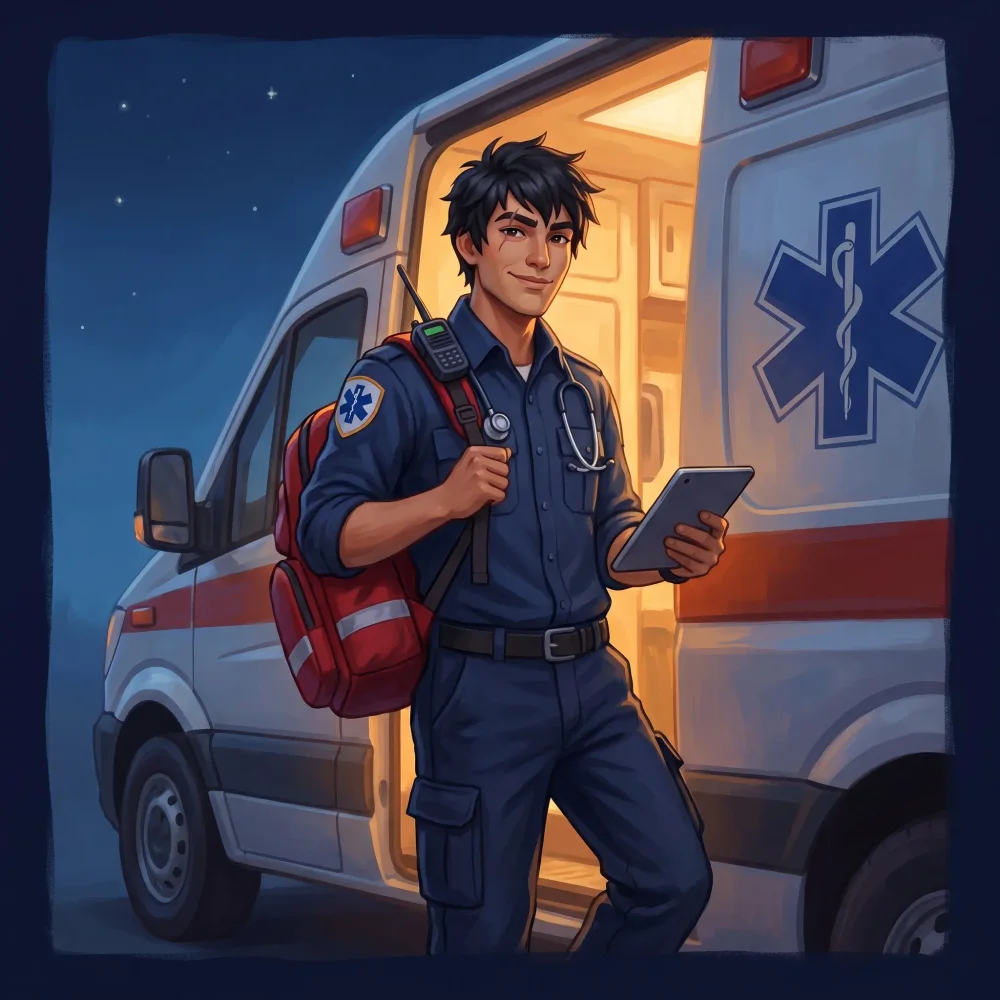
Pick as many as you like. Each one is built the same way: short lessons, drills, and review that remembers what you forget.
Not in the library? Wish for it and the Genie builds the course: lessons, quizzes, flashcards
AEMT Exam Prep · Lesson 1 of 20 · 8 min
The scope step up from EMT, who has to authorize it, and how the exam is built.
You are about to spend real time getting ready for the AEMT exam, and it helps to start with what the letters actually mean for your hands and your license. An AEMT carries more tools than an EMT: an IV line, a needle into bone when a vein will not cooperate, a supraglottic airway when a mask is not enough, and a short list of medications you give yourself rather than only assist a patient with. None of that makes you a paramedic. The next four lessons in this part walk through the skills themselves. This one lays out what the level adds, who has to say yes before you can use it, and how the exam itself is built.
OmniTaught is not accredited by CAPCE and is not approved by any state EMS office. Nothing here counts as continuing education hours, and nothing here counts toward NREMT recertification. This course is study material: a way to learn and practice the content the exam covers, not a substitute for an accredited AEMT program or a credential of any kind.
The national description of the level is specific about the size of the step up. An AEMT performs focused advanced skills and pharmacological interventions engineered to mitigate specific life threatening conditions, and that is a narrower promise than a paramedic's wide range of tools. The preparation beyond EMT exists because reasonably safe, evidence based interventions are available for common emergencies, not because an AEMT is meant to do everything a paramedic does. In a system with no paramedic coverage, an AEMT may be the most trained person who reaches the patient before the hospital does, which is exactly why the added skills matter and exactly why they stay limited.
None of that authority comes from finishing a course. The national scope of practice model is blunt about it: a person may only perform a skill or role for which that person is educated, certified, licensed, and credentialed, and all four have to be true at once. Education is what a program teaches you. Certification is proof you can do it. Licensure is the state's legal permission. Credentialing is your own medical director saying yes, specifically, for you. A newly certified AEMT is not automatically credentialed to give every medication on the national list; the local medical director still has to sign off, even in a state that authorizes the widest possible scope.
Passing the exam proves you know the material. It does not, by itself, put a single skill in your hands. Medical oversight is part of the definition of the level, not an add-on: the AEMT is described as working with medical oversight required and minimal autonomy for limited advanced skills.
The exam is not only asking whether you know a fact. It also samples a processing cycle every EMS clinician moves through on a call: recognize cues, analyze cues, define a hypothesis, generate solutions, take action, and evaluate. You re-enter that cycle every time the patient's presentation changes, which is why a single scenario question can shift what it is asking partway through. Clinical Judgment is also the largest single content domain on the exam, which tells you plainly that the exam cares less about a list memorized in order and more about what you do with a patient in front of you.
The AEMT Certification Examination is a computer based test. Candidates have three hours to complete it, and it consists of 135 items, 35 of which are unscored pilot questions collecting data for future exams. You will not know which ones those are, so every item gets your full attention. The content is organized into six domains: the four clinical areas identified by the practice analysis, EMS Operations, and Clinical Judgment. The AEMT carries a defined list of medications, and individual training programs may add others used locally, so what you are handed on your first day can be a little wider than the national floor. The rest of this part of the course works through the clinical skills domain by domain; this lesson is the only place the exam format itself gets this much attention.
Local protocol and your medical director govern what you actually do on a call. Where a state or a service authorizes more, or less, than the national description here, follow your own protocol, not this lesson.
Recalling from memory is what makes learning stick, so OmniTaught has you do it three ways: write the key idea in your own words, answer a quiz while the lesson is fresh, and review it just before you would forget.Sources: 2025 American Heart Association Guidelines for CPR and Emergency Cardiovascular Care; 2021 National Guideline for the Field Triage of Injured Patients; 2019 National EMS Scope of Practice Model; NASEMSO National Model EMS Clinical Guidelines; 2021 National EMS Education Standards, with NHTSA's instructional guidelines; National Registry of EMTs test plan for the AEMT examination; StatPearls, National Institutes of Health.
Start with the shelf built for first responders, then search for anything else. If it is missing, the Topic Genie builds it, and then everyone has it.
Try "I want to help clients with panic", "pass my nursing boards", or "stop being bad at percentages".
Topic Genie
Tell the Genie what you want to learn, what you already know, and what it is for. It writes a custom course tailored to you, with lessons, quizzes, and reviews.
One free course for signing up.
Every granted wish goes in the Wish Library, a growing collection of learner-made courses that anyone can add to their app for free. One person's wish becomes everyone's course.
Make a wish β¦
Who builds this
OmniTaught is built by Michael C. Shedrick, M.S., PLPC, NCC: a teacher with a master's in educational leadership who became a National Certified Counselor. He built the learning app the research says should exist. Lessons stay short, because attention fades fast. A quiz follows at once, because pulling an idea back out of your own head is what makes it stay, not reading it twice. And review comes just before you would forget, when the effort of remembering does the most good.
Also from the same desk: OmniPsyche Counseling Tools, which preps your next session and not just your notes; OmniPsyche.org, free mental health education with no paywall and no signup; and NOTICE, a free guided meditation app.
Ten minutes a day. Start with the topic your work depends on, or the one that has bugged you since school.
Start learning free
Your hero
Seven heroes, twenty-five levels, and a story told a chapter at a time. Advance your hero's quest with every completed lesson and find loot at every new level.
Mage
Warrior
Scholar
Druid
Rogue
Bard
PaladinNo card to start.
Flashcard apps have the science but no content. Content sites have no retention engineering. This one has both.