
A study desk in warm window light: an open laptop showing the OmniTaught Medical Emergency Prep for EMTs course, a mug of coffee, an open notebook with a fountain pen, and reading glasses
A hand holding a phone running the OmniTaught app, at a sunlit table with a mug of coffee and a notebook
OmniTaught ๐Ÿ”ฅ 6Topics

Course

Medical Emergency Prep for EMTs

4 of 7 lessons complete

โœ“ Allergy, Anaphylaxis, Infection and Sepsis
The epinephrine autoinjector, spotting sepsis, protecting yourself, cleaning the rig ยท 7 min
100%
6 Abdominal, GI and Genitourinary Complaints
The acute abdomen, GI bleeding, kidney stones, and care after sexual assault ยท 7 min
7 Behavioral Emergencies
Scene safety, de-escalation, the suicidal patient and 988, restraint as a last resort ยท 7 min
8 Medical Emergencies Timed Set
25 items, 30 minutes, exam mode ยท 30 min

Lesson 5

Poisoning and Overdose

A poison gets in one of four ways: swallowed, inhaled, injected, or absorbed through the skin. On every one of these calls your own safety comes first, because the thing that hurt the patient may still be in the room. After that, the airway and breathing matter far more than knowing the exact substance.

Opioids include heroin, fentanyl and prescription pain pills. The overdose picture has three parts: slow or absent breathing, pinpoint pupils and unresponsiveness. The patient dies from not breathing, so that is what you fix first. Open the airway and ventilate with a bag-valve-mask and oxygen. Then give naloxone per protocol while your partner keeps ventilating. If there is no pulse, this is a cardiac arrest: start CPR and use the AED.

  • What the substance was, and how much.
  • When it happened, and by what route.
  • What has been done already.

Quiz now, while it is fresh. 8 questions, no timer.

1 of 8

A 31-year-old man is unresponsive on a bathroom floor with pinpoint pupils, blue lips, a breathing rate of 4 and a strong pulse. What do you do FIRST?

The question on the screen is a real one

Medical Emergency Prep
for EMTs

7 lessons, 81 practice questions, 42 flashcards, and 1 timed exam set. Other First Responder Courses.

Other First Responder Courses

Built the same way, and every one of them is included.

And if the thing you need is not on the shelf at all, the Topic Genie builds a full course on anything you name, with the same lessons, questions and review schedule as this one.

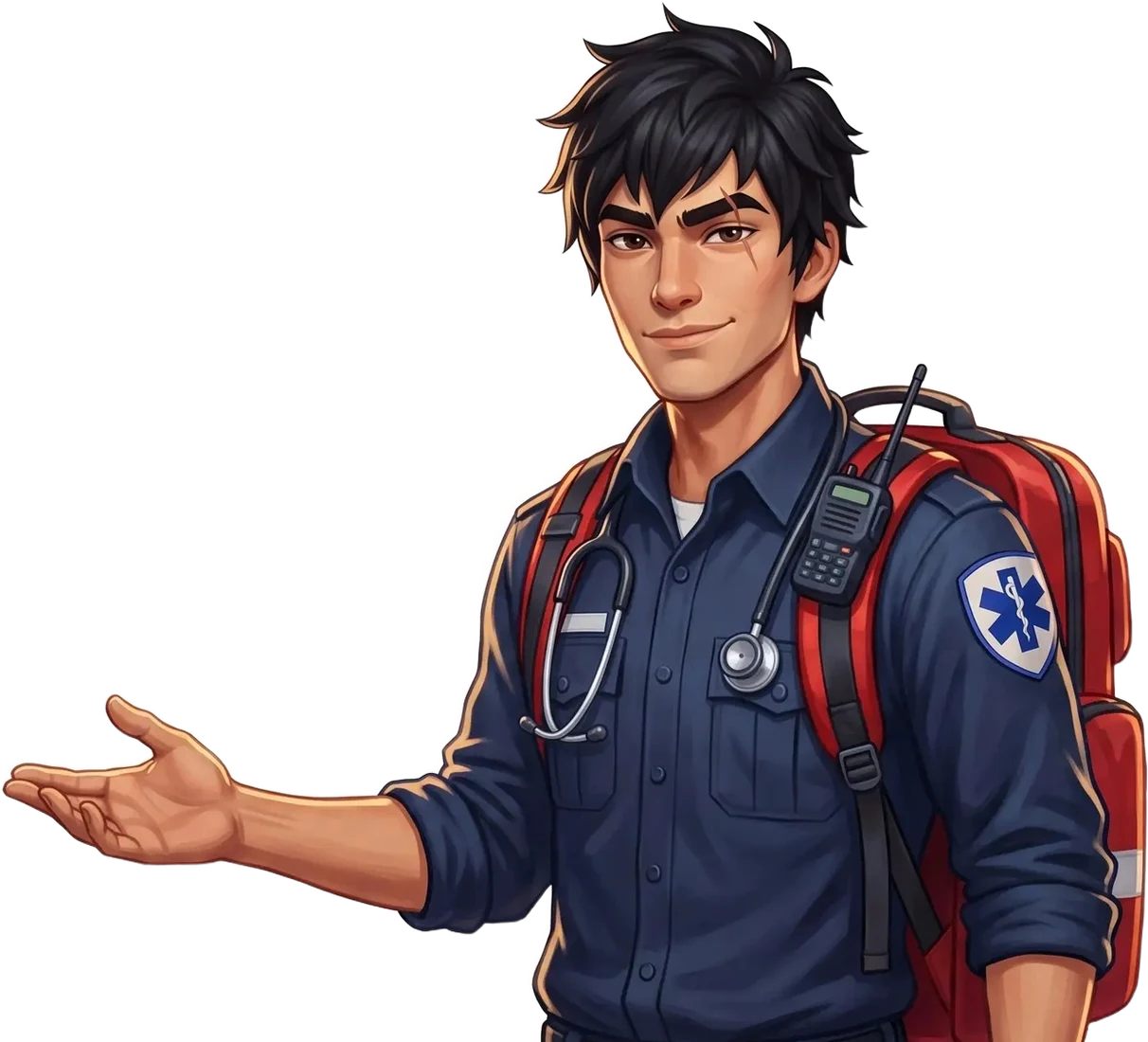
An EMT in a navy uniform with a red jump bag on his back, smiling, holding out an open hand toward the courses

Who builds this

Built by a teacher who became a National Certified Counselor.

OmniTaught is developed by Michael C. Shedrick, M.S., PLPC, NCC: a teacher with a master's degree in educational leadership who went on to become a National Certified Counselor. Both jobs kept exposing the same problem: learning tools that stop at definitions. So this course teaches the working version of its subject, the part you actually use when the real thing is in front of you, and it teaches it the way memory works: a short lesson, a quiz while it is still fresh, and review that brings it back before you lose it.

Also from the same desk, in case they are useful: OmniPsyche Counseling Tools, which preps your next session and not just your notes; OmniPsyche.org, free mental health education with no paywall and no signup; and NOTICE, a free guided meditation app.

What this course covers

Every lesson is short enough to finish in one sitting and ends with questions that make you use what you just read. The last ones are timed, in exam conditions.

  1. Respiratory Disease and the Prescribed InhalerAsthma, COPD, pneumonia, pulmonary edema, spontaneous pneumothorax, inhaler help7 min
  2. Neurology: Seizures, Confusion, Headache and FaintingSeizures, altered mental status, headache, syncope, and dementia versus delirium7 min
  3. Diabetic Emergencies, Dialysis and Sickle CellLow and high blood sugar, oral glucose, dialysis complications, sickle cell crisis7 min
  4. Allergy, Anaphylaxis, Infection and SepsisThe epinephrine autoinjector, spotting sepsis, protecting yourself, cleaning the rig7 min
  5. Poisoning and OverdoseOpioids and naloxone, carbon monoxide, alcohol and withdrawal, poison control7 min
  6. Abdominal, GI and Genitourinary ComplaintsThe acute abdomen, GI bleeding, kidney stones, and care after sexual assault7 min
Show all 8 lessonsShow fewer
  1. Behavioral EmergenciesScene safety, de-escalation, the suicidal patient and 988, restraint as a last resort7 min
  2. Medical Emergencies Timed Set25 items, 30 minutes, exam mode30 min

A whole lesson, start to finish

Not a sample and not a summary. This is all of lesson 2, exactly as it reads in the app, and then one of the 8 questions that follow it.

Lesson 2 of 8 · about 7 min

Neurology: Seizures, Confusion, Headache and Fainting

Seizures, altered mental status, headache, syncope, and dementia versus delirium

The brain needs a steady supply of oxygen and sugar, and it shows trouble in a few ways: shaking, confusion, pain, or a sudden drop to the floor. You will not find the exact cause in the field. You can protect the airway, find what is fixable, and tell the hospital a clear story with times in it.

Seizures

In a generalized seizure the patient goes stiff, then jerks all over, often with a bitten tongue and lost bladder control. While it is happening, move objects away, cushion the head, and time it. Do not hold the patient down and do not put anything in the mouth. When the jerking stops, roll the patient to the side, suction as needed and give oxygen. The sleepy, confused period afterward is the postictal state. It is expected, and it clears gradually.

A seizure that lasts more than about five minutes, or seizures that repeat without the patient waking between them, is status epilepticus. That is a life threat. Manage the airway, ventilate if breathing is inadequate, and call for ALS, who carry the drugs that stop it. Common causes of any seizure are missed seizure medication, low blood sugar, head injury, stroke, poisoning, alcohol withdrawal, and fever in a young child.

Altered mental status

Altered mental status is a sign, not a diagnosis. The list of causes is long: low oxygen, low blood sugar, stroke, seizure, overdose, infection, head injury, and alcohol. Alcohol on the breath does not rule out any of the others, so never assume a confused patient is only drunk. Work it the same way every time: airway, breathing, oxygen if needed, then look for medical causes such as low blood sugar, stroke or head injury. If you suspect stroke, use a named scale such as the Cincinnati Prehospital Stroke Scale (facial droop, arm drift, abnormal speech), and find out the time the patient was last known well. That time decides which treatments the hospital can offer.

Headache

Most headaches are not emergencies. These findings change that:

  • A sudden, severe headache described as the worst of the patient's life, which suggests bleeding in or around the brain.
  • Headache with fever and a stiff neck, which suggests meningitis. Put a mask on yourself and the patient.
  • Headache with weakness, vision loss, trouble speaking or confusion.
  • Headache after a head injury, or with a very high blood pressure.

Syncope

Syncope is a brief loss of consciousness from a drop in blood flow to the brain, with a quick and full recovery. A simple faint usually has a trigger and a warning: standing in the heat, pain, the sight of blood, then lightheadedness and tunnel vision. Fainting that comes from the heart looks different. Be worried when it happens during exertion, with no warning, with palpitations or chest pain, or in an older patient. Check for injuries from the fall, take vital signs, and transport. A patient who is not back to normal within a few minutes did not simply faint.

Dementia versus delirium

Dementia comes on slowly over months to years and stays fairly steady from day to day. Delirium comes on suddenly, over hours to days. It rises and falls, the patient cannot hold attention, and may see things that are not there. Delirium has a medical cause, often an infection such as a urinary infection in an older adult, a medication, low oxygen or low blood sugar, and it is often reversible. A patient with dementia can also develop delirium. Ask the caregiver two questions: is this normal for them, and when did it change?

Remember

Confusion always has a cause. A sudden change in thinking is a medical emergency until proven otherwise, at any age and with or without alcohol on the breath.

Stay grounded

Which stroke scale you use, whether you check blood glucose, and where stroke patients go are set by your local protocols and your medical director. They govern real practice.

A 27-year-old man is actively convulsing on the floor of a store when you arrive. What do you do FIRST?

Where this comes from

OmniTaught is an independent study app and does not represent the National Registry of EMTs, any government agency or any EMS authority. This course is study material: it is not continuing education credit and does not count toward recertification. On real calls your local protocols and medical director come first. If you or a colleague are in crisis, call or text 988, the Suicide and Crisis Lifeline.

Official sources: National EMS Scope of Practice Model (PDF) · SAMHSA, the 988 Lifeline

Questions people ask

Is there an app for EMTs to study medical emergencies?

Yes. OmniTaught opens in any browser and installs to a phone or a computer like an app, and it works offline once you have opened it. Medical Emergency Prep for EMTs is 7 lessons, 81 practice questions and 42 flashcards, and the first week is free with no card.

What does Medical Emergency Prep for EMTs cover?

Breathing, brain, sugar, allergy, infection, poison, and behavior. It is 7 lessons long, plus 1 timed exam set in exam conditions, and every lesson ends with questions on what you just read.

How long is each lesson?

About 7 minutes. There are 7 of them, so the reading comes to about 49 minutes in total, and it is built to be done a lesson at a time rather than in one sitting.

How much practice is in it?

81 practice questions, every one with an explanation of why the right answer is right, plus 42 flashcards that come back on a schedule built from how well you knew them last time.

What does it cost?

Nothing for the first week, and no card is asked for. After that OmniTaught is $9.99 a month or $79 a year, which opens every course on the site, this one included, plus one Genie course a month.

Free for a week. Then $9.99 a month.

No card to start.

EVERYTHING INCLUDED
$9.99a month, or $79 a year
  • Every course in the ever-growing library, every quiz, & your review deck.
  • One Genie course a month, built on whatever you name. Extra courses are $6.99 each. Add narration to any Genie made course for $9.99.
  • A free week first, no card needed. Cancel any time from Settings.
Start Medical Emergency Prep for EMTs free

Flashcard apps have the science but no content. Content sites have no retention engineering. This one has both, built one craft at a time.