Example: I want to understand statistics well enough to read research papers without getting lost.
What do you already know?
Be honest, zero judgment. Example: I passed a stats class ten years ago and remember almost nothing.
Where will you use it?
Example: I am a paramedic and want to understand the ventilator settings my patients arrive on.
Your wishes
✦ You have 1 wish. Granting a course spends one.
OmniTaughtA
Lv 1Lv 270 XP to go
Paramedic Exam Prep · Lesson 1 of 21 · 8 min
The paramedic's role, the law, medical direction, and how clinical judgment is tested
What the law says a paramedic is, who backs you up, and how the exam grades your thinking
0:00 / 8:00
1x1.25x1.5x
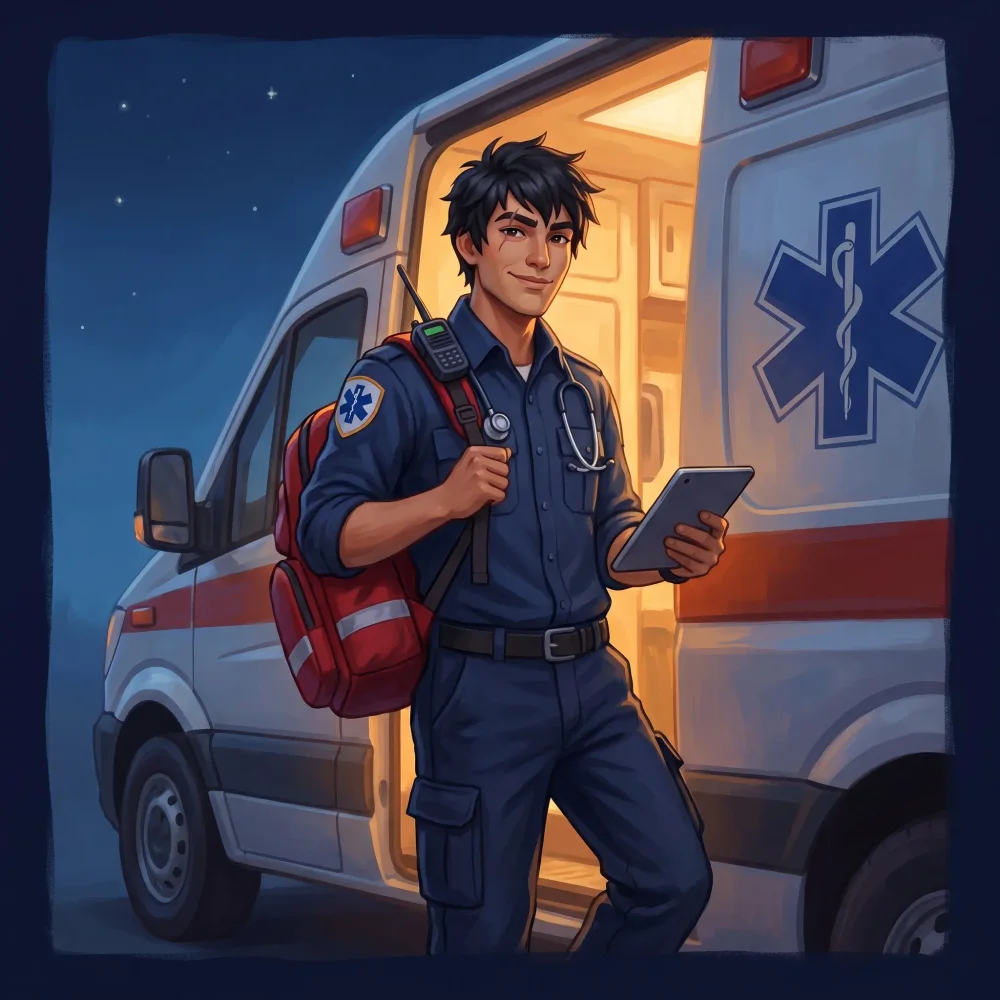
You are starting the hardest jump in EMS education, the one from EMT or AEMT to paramedic. Before a single airway or drug comes up, you need to understand what the law actually says you are, who stands behind you when you make a call in someone's living room at three in the morning, and how the certification exam is built to test the thinking behind your hands, not just the skills in them. This lesson is the map for the rest of the course.
What the law says you are
The national scope of practice model that every state EMS office works from describes the paramedic as a health professional whose primary focus is to respond to, assess, and triage emergent, urgent, and non-urgent requests for medical care. You apply both basic and advanced knowledge, administer medications, and interpret diagnostic findings to guide treatment. You also know when a patient's needs have outgrown what you can provide and a higher level of care is what they need next. That last part matters as much as any skill taught in this course. Recognizing the edge of your own scope is itself a tested competency, not a footnote.
The thing to rememberYour certification is your own. A medical director's oversight extends your reach; it does not replace your judgment, and it is not the license you are practicing under. That license is yours, and so is the thinking the exam is built to test.
Quiz now, while it is fresh. 8 questions, no timer.
OmniTaughtA
The paramedic's role, the law, medical direction, and how clinical judgment is tested
The one thing worth keeping
Your most valuable takeaway · +30 XP
What is the single most valuable thing you take from this lesson? One sentence is plenty.
The most valuable thing here is...
One sentence earns you 30 XP, the moment you save it. It goes into your notes for this lesson too.
OmniTaughtA
←1/8
OmniTaughtA
Lv 1Lv 270 XP to go
Congrats, perfect!
Paramedic Exam Prep · The paramedic's role, the law, medical direction, and how clinical judgment is tested
100%
+75 XP · first pass
Nothing missed. Six flashcards joined your review deck.
Level up
You've just reached Level 2!
Student
115 XP
Your story · chapter 2
The town is gone behind the trees and the map is already wrong. You correct it as you walk, boots in muck to the ankle, ink going everywhere.
On this rung · 2 rewards
New card back
Summitfor your review deck
New card back
Northern Lightsfor your review deck
Next · Level 3 Reader
135 XP to go
OmniTaughtA
For first responders
More on the first responder shelf
🚑EMR Exam Prep18 lessons · For First Responders
💉AEMT Exam Prep20 lessons · For First Responders
RxMedical Terminology12 lessons · For First Responders
🚑EMT Exam Prep28 lessons · For First Responders
🫁Airway and Ventilation Prep for EMTs6 lessons · For First Responders
Every course here is included. One account, the whole shelf.
Prep for the Paramedic exam and sharpen your medic skills.
930 practice questions, 15 lessons, 6 practice sets and 1 timed exam set. Or browse our other first responder courses.
You would be amazed what you could learn in six months with just ten minutes a day.
How it works
930practice questions
1timed exam set
Create a custom course, or pick from our library.
OmniTaught5 day streakA
Lv 9Lv 101,200 XP to go
Topics
Pick as many as you like. Each one is built the same way: short lessons, drills, and review that remembers what you forget.
Topic Genie ✦MAKE ONE
Not in the library? Wish for it and the Genie builds the course: lessons, quizzes, flashcards
Short lessons.
OmniTaught5 day streakA
Lv 9Lv 101,200 XP to go
Paramedic Exam Prep · Lesson 1 of 21 · 8 min
The paramedic's role, the law, medical direction, and how clinical judgment is tested
What the law says a paramedic is, who backs you up, and how the exam grades your thinking
0:00 / 5:51
You are starting the hardest jump in EMS education, the one from EMT or AEMT to paramedic. Before a single airway or drug comes up, you need to understand what the law actually says you are, who stands behind you when you make a call in someone's living room at three in the morning, and how the certification exam is built to test the thinking behind your hands, not just the skills in them. This lesson is the map for the rest of the course.
What this course is not
OmniTaught is not accredited by CAPCE and is not approved by any state EMS office. These lessons are study material. They do not count as continuing education hours and they do not count toward National Registry recertification. Read them to sharpen what you already know and find the gaps before your program or your exam does, and get your hours from an approved provider.
What the law says you are
The national scope of practice model that every state EMS office works from describes the paramedic as a health professional whose primary focus is to respond to, assess, and triage emergent, urgent, and non-urgent requests for medical care. You apply both basic and advanced knowledge, administer medications, and interpret diagnostic findings to guide treatment. You also know when a patient's needs have outgrown what you can provide and a higher level of care is what they need next. That last part matters as much as any skill taught in this course. Recognizing the edge of your own scope is itself a tested competency, not a footnote.
Your license, not the doctor's
A license is the official or legal permission to engage in or perform a regulated activity, and yours belongs to you. Paramedics have worked under the supervision of physician medical directors since the 1960s, and that oversight has real teeth: your medical director writes the protocols you follow and can pull your local credential. But it is a mistake, and an old one, to think you are borrowing the physician's license when you work a call. You are not. EMS personnel hold their own license, and the relevant state authority, not the medical director, is what can restrict or remove it if your practice turns incompetent or dangerous. Medical direction is oversight, not a loan. You practice under the oversight of physician medical directors, but the judgment calls in the room are yours, made under protocols and, when a situation calls for it, a voice on the radio.
Where clinical judgment fits
The exam does not stop at asking whether you know the right drug or the right rhythm. A newer domain called Clinical Judgment now sits alongside the traditional content areas. It was defined through the 2021 National EMS Practice Analysis Addendum, and it counts for more than any other single area, because topics most critical for patient care are weighted more heavily than the rest. It is built around a cycle you move through on every call, whether you notice yourself doing it or not.
Recognize cues: notice what is actually in front of you, not what you expected to find.
Analyze cues: sort what matters from what does not, and start building a picture.
Define a hypothesis: commit to a working idea of what is wrong.
Generate solutions: line up the reasonable ways to act on that idea.
Take action: do the thing, do not just think about it.
Evaluate: check whether it worked, and be willing to go back to step one.
What the exam covers, and how it is built
Candidates have three and a half hours to complete the Paramedic Certification Examination, and you will be required to answer a minimum of 110 items on a computer that adjusts to how you are doing as you go. Mixed into that count are 20 unscored pilot items, included to collect data on whether a new question is fair before it becomes a scored one. You cannot tell which items these are, so there is no shortcut in guessing at them. The content is organized into six domains, the traditional patient-care areas plus EMS Operations and Clinical Judgment, and none of them can be studied in isolation, because the exam's real subject is how you think across all of them at once.
The thing to remember
Your certification is your own. A medical director's oversight extends your reach; it does not replace your judgment, and it is not the license you are practicing under. That license is yours, and so is the thinking the exam is built to test.
What this level does not include yet
Not everything a paramedic could physically do is something a paramedic program teaches or certifies. Rapid sequence induction for intubation is legally permitted in some states, but it is usually not taught as part of initial education and is not part of the certification process. Where it exists at all, it belongs to a small group of clinicians whose local system has taken on the extra training and oversight it requires. If a scenario in this course, or on your exam, seems to reach past what you have been taught, the answer is almost never the most advanced-sounding option. It is the one that fits what a paramedic is actually certified to do.
Stay grounded
Everything in this lesson describes the national model. Your own state, your own service, and your own medical director set the protocols you actually work under, and they govern real practice, not this course.
Quizzes tell your brain this is important.
OmniTaught5 day streakA
Lv 9Lv 101,200 XP to go
Review, timed for just before you would forget.
OmniTaught5 day streakA
Lv 9Lv 101,200 XP to go
Recalling from memory is what makes learning stick, so OmniTaught has you do it three ways: write the key idea in your own words, answer a quiz while the lesson is fresh, and review it just before you would forget.Sources: 2025 American Heart Association Guidelines for CPR and Emergency Cardiovascular Care; 2021 National Guideline for the Field Triage of Injured Patients; 2019 National EMS Scope of Practice Model; NASEMSO National Model EMS Clinical Guidelines; 2021 National EMS Education Standards, with NHTSA's instructional guidelines; National Registry of EMTs test plan for the Paramedic examination; StatPearls, National Institutes of Health.
First responder topics, and much more
Start with the shelf built for first responders, then search for anything else. If it is missing, the Topic Genie builds it, and then everyone has it.
Try "I want to help clients with panic", "pass my nursing boards", or "stop being bad at percentages".
Topic Genie
Wish for a topic. Watch it become a course.
Tell the Genie what you want to learn, what you already know, and what it is for. It writes a custom course tailored to you, with lessons, quizzes, and reviews.
One free course for signing up.
Every granted wish goes in the Wish Library, a growing collection of learner-made courses that anyone can add to their app for free. One person's wish becomes everyone's course.
Built by a teacher who became a National Certified Counselor.
OmniTaught is built by Michael C. Shedrick, M.S., PLPC, NCC: a teacher with a master's in educational leadership who became a National Certified Counselor. He built the learning app the research says should exist. Lessons stay short, because attention fades fast. A quiz follows at once, because pulling an idea back out of your own head is what makes it stay, not reading it twice. And review comes just before you would forget, when the effort of remembering does the most good.
Also from the same desk: OmniPsyche Counseling Tools, which preps your next session and not just your notes; OmniPsyche.org, free mental health education with no paywall and no signup; and NOTICE, a free guided meditation app.
Be the one who knows their stuff.
Ten minutes a day. Start with the topic your work depends on, or the one that has bugged you since school.
Choose your hero and watch them level up as you learn.
Seven heroes, twenty-five levels, and a story told a chapter at a time. Advance your hero's quest with every completed lesson and find loot at every new level.
Mage
Warrior
Scholar
Druid
Rogue
Bard
Paladin
Free for a week. Then $9.99 a month.
No card to start.
EVERYTHING INCLUDED
$9.99a month, or $79 a year
Every course in the ever-growing library, every quiz, & your review deck.
One Genie course a month, built on whatever you name. Extra courses are $6.99 each. Add narration to any Genie made course for $9.99.
A free week first, no card needed. Cancel any time from Settings.


 Lv 1Lv 270 XP to go



 Lv 9
Lv 9 Lv 9
Lv 9 Lv 9
Lv 9 Lv 9
Lv 9


 Mage
Mage Warrior
 Druid
Druid Rogue
Rogue Bard
Bard Paladin