
A study desk in warm window light: an open laptop showing the OmniTaught Cardiology and Resuscitation Prep for EMTs course, a mug of coffee, an open notebook with a fountain pen, and reading glasses
A hand holding a phone running the OmniTaught app, at a sunlit table with a mug of coffee and a notebook
OmniTaught ๐Ÿ”ฅ 6Topics

Course

Cardiology and Resuscitation Prep for EMTs

4 of 6 lessons complete

โœ“ Cardiac arrest: CPR, the AED and the team
What high-quality CPR means, how to run the AED, team roles, and children ยท 7 min
100%
6 Stroke: recognition, the clock and the destination
A named stroke scale, last known well, the mimics, and where the patient goes ยท 7 min
7 Cardiology and Resuscitation Timed Set
25 items, 30 minutes, exam mode ยท 30 min

Lesson 5

Special arrests, a returned pulse, and when to stop

Good compressions and an early shock are the base of every arrest. A few situations add a step, because the cause of the arrest is different. Then come two harder questions: what to do when the pulse comes back, and when CPR should not be started or should end.

  • Drowning: the cause is lack of oxygen, so open the airway and give breaths early. Do not try to press water out of the lungs.
  • Opioid overdose: in arrest, CPR with good ventilation comes first. Naloxone is given per protocol and never replaces compressions and breaths.
  • Hypothermia: a cold heart is irritable, so handle the patient gently. Take longer than usual to look for a pulse and breathing, as your protocol directs. If there is none, do CPR, use the AED, stop further heat loss and transport. A cold patient is not declared dead in the field just because of the cold.
  • Late pregnancy: flat on her back, the uterus presses on the large vessels and blocks blood returning to the heart. One rescuer pushes the uterus to the patient's left by hand while CPR goes on. Move compression hand position slightly higher on the sternum. The AED stays the same. Move quickly.
  • Trauma: the cause is usually blood loss or a blocked airway. Stop the bleeding, open the airway, and transport fast per protocol.
  • Electricity and lightning: make the scene safe first. These patients can often do well with early CPR and the AED, especially if it starts fast.

Return of spontaneous circulation (ROSC) shows up as movement, coughing, breathing or a pulse you can feel. The minutes after it are fragile.

Quiz now, while it is fresh. 8 questions, no timer.

1 of 8

A 17-year-old was pulled from a lake. He is pulseless and not breathing, and his chest is wet. What is the right approach?

The question on the screen is a real one

Cardiology and Resuscitation Prep
for EMTs

6 lessons, 73 practice questions, 36 flashcards, and 1 timed exam set. Other First Responder Courses.

Other First Responder Courses

Built the same way, and every one of them is included.

And if the thing you need is not on the shelf at all, the Topic Genie builds a full course on anything you name, with the same lessons, questions and review schedule as this one.

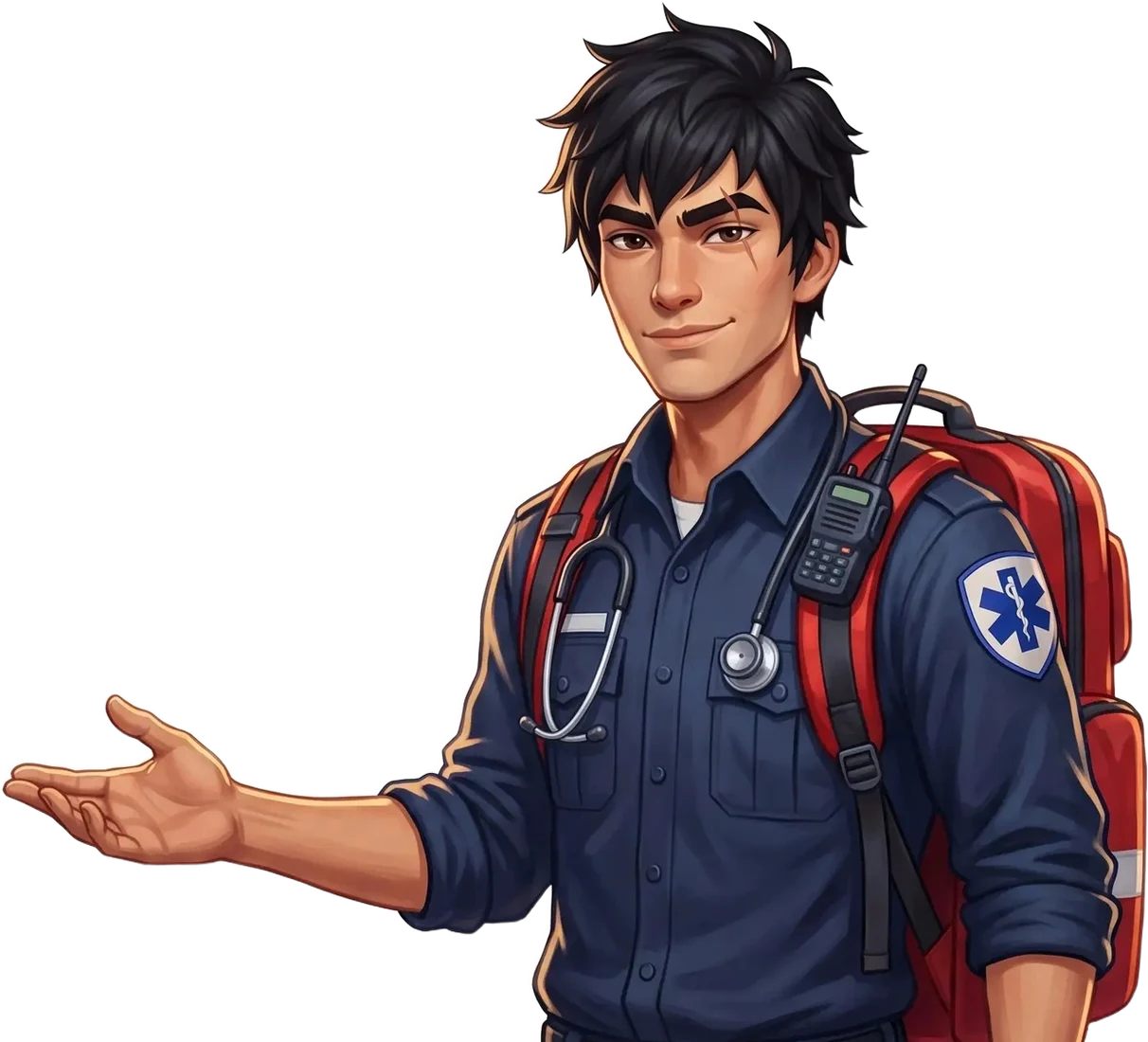
An EMT in a navy uniform with a red jump bag on his back, smiling, holding out an open hand toward the courses

Who builds this

Built by a teacher who became a National Certified Counselor.

OmniTaught is developed by Michael C. Shedrick, M.S., PLPC, NCC: a teacher with a master's degree in educational leadership who went on to become a National Certified Counselor. Both jobs kept exposing the same problem: learning tools that stop at definitions. So this course teaches the working version of its subject, the part you actually use when the real thing is in front of you, and it teaches it the way memory works: a short lesson, a quiz while it is still fresh, and review that brings it back before you lose it.

Also from the same desk, in case they are useful: OmniPsyche Counseling Tools, which preps your next session and not just your notes; OmniPsyche.org, free mental health education with no paywall and no signup; and NOTICE, a free guided meditation app.

What this course covers

Every lesson is short enough to finish in one sitting and ends with questions that make you use what you just read. The last ones are timed, in exam conditions.

  1. Perfusion and shockHow the body hides shock, the four kinds, and why a falling pressure is a late sign7 min
  2. Chest pain and acute coronary syndromeSpotting it, the patients who hide it, aspirin, and the rules for nitroglycerin7 min
  3. Heart failure, high pressure, the aorta and clotsTelling apart the chest and breathing emergencies that are not a heart attack7 min
  4. Cardiac arrest: CPR, the AED and the teamWhat high-quality CPR means, how to run the AED, team roles, and children7 min
  5. Special arrests, a returned pulse, and when to stopDrowning, overdose, cold, pregnancy, post-arrest care, and withholding or ending CPR7 min
  6. Stroke: recognition, the clock and the destinationA named stroke scale, last known well, the mimics, and where the patient goes7 min
Show all 7 lessonsShow fewer
  1. Cardiology and Resuscitation Timed Set25 items, 30 minutes, exam mode30 min

A whole lesson, start to finish

Not a sample and not a summary. This is all of lesson 2, exactly as it reads in the app, and then one of the 8 questions that follow it.

Lesson 2 of 7 · about 7 min

Chest pain and acute coronary syndrome

Spotting it, the patients who hide it, aspirin, and the rules for nitroglycerin

Acute coronary syndrome (ACS) starts when a coronary artery narrowed by plaque is blocked by a clot. The muscle past the block runs short of oxygen. If the artery is not opened, that muscle dies. You cannot tell unstable angina from a heart attack in a living room, and you do not need to. Both are ACS, and both get the same care.

The classic picture

The patient describes pressure, squeezing, tightness or a weight on the chest, more often than sharp pain. It may spread to an arm, the jaw, the neck or the back. Sweating, nausea, shortness of breath and a sense that something is badly wrong come with it. Cool, clammy skin is a warning sign the heart is going into shock. Stable angina comes on with effort and eases within minutes of rest or nitroglycerin. Pain that arrives at rest, is new, lasts longer or no longer responds is treated as ACS.

The patients who hide it

Women, older adults and people with diabetes often have no chest pain at all. They call for sudden tiredness, shortness of breath, nausea, pain in the upper belly that feels like indigestion, an aching jaw or back, fainting. Keep a low threshold. If the story has no better explanation, treat it as the heart.

What an EMT does

  • Rest. Position of comfort, calm voice, and no walking to the stretcher. Effort raises the heart's demand for oxygen.
  • Oxygen for a low saturation, shortness of breath or signs of shock, per protocol. A comfortable patient with a normal saturation does not need a mask.
  • Aspirin, 162 to 325 mg, chewed. It keeps platelets from adding to the clot. It is not for pain. Withhold it for a true aspirin allergy or active bleeding in the gut.
  • The patient's own nitroglycerin, under the rules below.
  • Call ALS and notify the hospital early. Acquire a 12-lead where local protocol allows. The destination should be able to open the artery.
  • Keep the AED close. These patients can arrest in front of you.

Assisting with nitroglycerin

Nitroglycerin widens blood vessels, which eases the heart's workload. It also drops blood pressure, and that is the danger. Before you assist, every item on this list has to be true:

  1. It is prescribed to this patient and is not expired.
  2. The systolic pressure is above 90 to 100, by your protocol.
  3. The patient has not taken an erectile dysfunction drug such as sildenafil or tadalafil recently. Ask every patient, plainly and in private if you can. Some people take these drugs for lung conditions.
  4. The patient has had fewer than three doses for this episode.

The dose is 0.4 mg, a tablet or a spray under the tongue. Recheck the blood pressure before every dose and about five minutes after. Doses are five minutes apart, to a total of three. If the pressure drops or the patient turns dizzy and pale, lay the patient flat, give no more, and tell ALS and the hospital.

Remember

Aspirin is for the clot, not the pain. Nitroglycerin needs a good systolic pressure, no erectile dysfunction drug, the patient's own prescription, and no more than three doses in total.

Stay grounded

Pressure cutoffs, the time window for erectile dysfunction drugs, oxygen targets and 12-lead use differ from one service to the next. Your local protocols and your medical director decide what you do on a real call.

A 58-year-old man has had crushing chest pain at rest for 20 minutes. He is sweaty, his blood pressure is 146/88, and he has no allergies, no bleeding history and no nitroglycerin. He is resting in a position of comfort. What should you do NEXT?

Where this comes from

OmniTaught is an independent study app and does not represent the National Registry of EMTs, any government agency or any EMS authority. This course is study material: it is not continuing education credit and does not count toward recertification. On real calls your local protocols and medical director come first. If you or a colleague are in crisis, call or text 988, the Suicide and Crisis Lifeline.

Official sources: National EMS Scope of Practice Model (PDF) · SAMHSA, the 988 Lifeline

Questions people ask

Is there an app for EMTs to study cardiology and CPR?

Yes. OmniTaught opens in any browser and installs to a phone or a computer like an app, and it works offline once you have opened it. Cardiology and Resuscitation Prep for EMTs is 6 lessons, 73 practice questions and 36 flashcards, and the first week is free with no card.

What does Cardiology and Resuscitation Prep for EMTs cover?

Chest pain, shock, stroke, and the arrest, inside the EMT scope. It is 6 lessons long, plus 1 timed exam set in exam conditions, and every lesson ends with questions on what you just read.

How long is each lesson?

About 7 minutes. There are 6 of them, so the reading comes to about 42 minutes in total, and it is built to be done a lesson at a time rather than in one sitting.

How much practice is in it?

73 practice questions, every one with an explanation of why the right answer is right, plus 36 flashcards that come back on a schedule built from how well you knew them last time.

What does it cost?

Nothing for the first week, and no card is asked for. After that OmniTaught is $9.99 a month or $79 a year, which opens every course on the site, this one included, plus one Genie course a month.

Free for a week. Then $9.99 a month.

No card to start.

EVERYTHING INCLUDED
$9.99a month, or $79 a year
  • Every course in the ever-growing library, every quiz, & your review deck.
  • One Genie course a month, built on whatever you name. Extra courses are $6.99 each. Add narration to any Genie made course for $9.99.
  • A free week first, no card needed. Cancel any time from Settings.
Start Cardiology and Resuscitation Prep for EMTs free

Flashcard apps have the science but no content. Content sites have no retention engineering. This one has both, built one craft at a time.