Example: I want to understand statistics well enough to read research papers without getting lost.
What do you already know?
Be honest, zero judgment. Example: I passed a stats class ten years ago and remember almost nothing.
Where will you use it?
Example: I want a ten-minute morning routine for a stiff lower back.
Your wishes
✦ You have 1 wish. Granting a course spends one.
OmniTaughtA
Lv 1Lv 270 XP to go
Yoga · Lesson 1 of 26 · 8 min
What Yoga Is
Where the word comes from, what the old texts meant by it, what a class is today, and the standing pose every other pose starts from
0:00 / 8:00
1x1.25x1.5x
The oldest picture said to show yoga is a small seal from Mohenjo-daro, a city of the ancient Indus civilization. Sir John Marshall, who led the dig, published his report in 1931. In it he describes a figure "seated on a couch or throne in the manner of an Indian yogi".
Then he adds a doubt: the legs are "different from that ordinarily prescribed for the various well-known asanas in which the yogi sits for his religious meditation" (asanas are postures; a yogi practises yoga). A colleague, Ramaprasad Chanda, was surer, and he pointed to a second find: a stone statue of a bearded man's head and shoulders. Its eyes are half closed and fixed on the tip of the nose, as a yogi's are in meditation, and those eyes, he argued, "proclaim this figure to be a yogi". A horned seal, he said, showed the god Shiva in a yogi's posture.
Nobody has settled it: some scholars read the seal as a yogi and others do not, and nothing on it names the figure or the pose.
This lesson covers the word, the history, the eight parts, a class today, what yoga is not, and Mountain pose.
Mountain pose
Standing tall and still: Mountain pose
Sanskrit: Tadasana, mountain pose (tada, a mountain, the usual reading). Why do it: Cleveland Clinic calls it your body's optimal posture and says it informs all other postures: you stand tall with your feet firmly planted, which reconnects you to your natural posture.
Stand with your feet hip-width apart, toes pointing forward.
Press into all four corners of your feet, then lift and lower your toes to create a firm, grounded base.
Draw your belly in. This tightens all the muscles in your midsection.
Roll your shoulders down and back to open your chest.
Tuck your chin slightly to lengthen the back of your neck.
Reach the crown of your head upward, creating a long spine.
Relax your arms at your sides with palms facing forward.
Breathe deeply and evenly, and hold for 30 to 60 seconds, or longer as you become more comfortable.
These are the Cleveland Clinic steps.
Where you feel it: The belly muscles, which Cleveland Clinic's yoga therapist says support the spine and take the pressure off the lower back. Harvard Health adds the inner arches of the feet, lifting up through the upper inner thighs. Cleveland Clinic's alignment check: hips over knees, knees over ankles, and knees straight but not locked.
Easier, and harderEasier: sit near the edge of a sturdy chair, feet flat and hip-width apart, and sit up tall from tailbone to crown. Harder: breathe in and raise your arms overhead, palms facing each other or touching, reaching through the fingertips, shoulders down. Deeper, Cleveland Clinic's mild backbend: hands behind your head, gently arch your upper back and lift your chest, head and neck in line with your spine. Go slow, and avoid it with back or balance issues.
Quiz now, while it is fresh. 8 questions, no timer.
OmniTaughtA
What Yoga Is
The one thing worth keeping
Your most valuable takeaway · +30 XP
What is the single most valuable thing you take from this lesson? One sentence is plenty.
The most valuable thing here is...
One sentence earns you 30 XP, the moment you save it. It goes into your notes for this lesson too.
OmniTaughtA
←1/8
OmniTaughtA
Lv 1Lv 270 XP to go
Congrats, perfect!
Yoga · What Yoga Is
100%
+75 XP · first pass
Nothing missed. Six flashcards joined your review deck.
Level up
You've just reached Level 2!
Student
115 XP
Your story · chapter 2
The town is gone behind the trees and the map is already wrong. You correct it as you walk, boots in muck to the ankle, ink going everywhere.
On this rung · 2 rewards
New card back
Summitfor your review deck
New card back
Northern Lightsfor your review deck
Next · Level 3 Reader
135 XP to go
OmniTaughtA
Life skills
More on the Life Skills shelf
🧠Study Less, Remember More3 lessons · Life Skills
$Personal Finance Basics12 lessons · Life Skills
☺Body Language Foundations10 lessons · Life Skills
✨AI for Everyday Life12 lessons · Life Skills
🌿Longevity46 lessons · Life Skills
Every course here is included. One account, the whole shelf.
Learn Yoga and build a practice that fits your body.
or learn anything with Custom Courses tailored to your needs.
I have found OmniTaught to be a wonderful learning tool, I find myself learning a lot and quickly. The app is easy to pick up and go! It provides TONS of courses and they all seem to be up to date with current materials.
Devin M.
How it works
Create a custom course, or pick from our library.
OmniTaught5 day streakA
Lv 9Lv 101,200 XP to go
Topics
Pick as many as you like. Each one is built the same way: short lessons, drills, and review that remembers what you forget.
Topic Genie ✦MAKE ONE
Not in the library? Wish for it and the Genie builds the course: lessons, quizzes, flashcards
Short lessons.
OmniTaught5 day streakA
Lv 9Lv 101,200 XP to go
Yoga · Lesson 1 of 26 · 8 min
What Yoga Is
Where the word comes from, what the old texts meant by it, what a class is today, and the standing pose every other pose starts from
The oldest picture said to show yoga is a small seal from Mohenjo-daro, a city of the ancient Indus civilization. Sir John Marshall, who led the dig, published his report in 1931. In it he describes a figure "seated on a couch or throne in the manner of an Indian yogi".
Then he adds a doubt: the legs are "different from that ordinarily prescribed for the various well-known asanas in which the yogi sits for his religious meditation" (asanas are postures; a yogi practises yoga). A colleague, Ramaprasad Chanda, was surer, and he pointed to a second find: a stone statue of a bearded man's head and shoulders. Its eyes are half closed and fixed on the tip of the nose, as a yogi's are in meditation, and those eyes, he argued, "proclaim this figure to be a yogi". A horned seal, he said, showed the god Shiva in a yogi's posture.
Nobody has settled it: some scholars read the seal as a yogi and others do not, and nothing on it names the figure or the pose.
This lesson covers the word, the history, the eight parts, a class today, what yoga is not, and Mountain pose.
What the word means
The word yoga comes from the Sanskrit root yuj, meaning to yoke or to unite. Harvard's public health school and Cleveland Clinic both give that root; Harvard reads it as connecting mind, body and spirit through breathing, meditation and poses.
The oldest rule book of yoga, the Yoga Sutras of Patanjali, defines it in its second line. In one translation: "Union is restraining the thought-streams natural to the mind." The next line: "Then the seer dwells in his own nature." The text that gave yoga its shape defines it as a quieting of the mind, not as exercise.
A short history
Yoga began in India as a spiritual practice, not as physical exercise. Harvard's public health school dates its origins to about 5,000 years ago, in religious texts recorded by priests. The National Institutes of Health (NIH) calls it an ancient and complex practice rooted in Indian philosophy. The Yoga Sutras have no agreed birthday: the 1914 standard English edition dated them between 300 and 500 CE (the same years as AD), and a 2025 journal paper prints 200 to 400 BCE (the same years as BC).
The poses came much later. The Hatha Yoga Pradipika, the text today's physical yoga traces back to, was written about the 15th century CE by Svatmarama. It describes posture as the first step, "for gaining steady posture, health and lightness of body". It presents hatha yoga, the yoga of postures and breath, as a staircase to raja yoga, its word for the goal: samadhi, the eighth limb listed below. Most poses in a modern class cannot be traced back more than about 150 years.
Yoga did not appear in the United States until the late 1800s: the monk Swami Vivekananda addressed the Parliament of World Religions in Chicago in 1893, then wrote a bestselling book, Raja Yoga. The poses of a modern class were systematized by Tirumalai Krishnamacharya, whom many consider the father of modern yoga; his students, among them B. K. S. Iyengar, carried them around the world.
The eight limbs
The Yoga Sutras list eight limbs: "self-restraint in actions, fixed observance, posture, regulation of energy, mind-control in sense engagements, concentration, meditation, and realization." A 2012 journal review gives each Sanskrit name a plain meaning.
Yama: universal ethics, how you treat others.
Niyama: individual ethics, how you treat yourself.
Asana: physical postures.
Pranayama: breath control.
Pratyahara: control of the senses.
Dharana: concentration.
Dhyana: meditation.
Samadhi: bliss, or in the translation above, realization.
Postures are one limb of eight, and the Yoga Sutras give them one rule: "The posture should be steady and comfortable." The NIH notes that classical yoga has other elements but that yoga as practised in the United States emphasizes the postures, the breathing and meditation.
What a class is today
Cleveland Clinic describes the styles. Hatha is a catchall term for any physical yoga with postures and breathwork; in the West it is also the name of a style of its own, excellent for beginners. Vinyasa, or flow, is active and moves through loops of postures. Iyengar yoga is slow and strong, and its hallmark is props: chairs, blocks and straps. Restorative and yin are slow and floor-based. Cleveland Clinic's advice: start with a basic class.
The NIH says yoga is generally considered safe for healthy people when performed properly, under a qualified instructor, and tells anyone new to yoga to avoid headstands, shoulder stands, the lotus position and forceful breathing. This course teaches none; lesson 24 explains them and their cautions.
Try it now
Put both feet flat on the floor, hip-width apart. Press down through all four corners of each foot: the two sides of the heel, the base of the big toe, the base of the little toe. Roll your shoulders down and back and breathe slowly three times.
What yoga is not
It is not a religion you must join. The old texts are devotional: the Yoga Sutras list "persevering devotion to God" among the observances. A class today need not be devotional. In 2013 a California judge ruled that a school district was not teaching religion in its elementary school yoga classes. Those classes had dropped the Sanskrit and renamed the lotus position the crisscross applesauce pose.
It is not only stretching. Harvard Health writes that yoga is not just about moving your body: it also features breathing and meditation, and the postures stretch and strengthen the core and other muscles.
It is not a contest. The Hatha Yoga Pradipika says success "cannot be attained by adopting a particular dress", that "It cannot be gained by telling tales", and that "Practice alone is the means to success." It also says, as the text's claim rather than a study's finding, that "Whether young, old or too old, sick or lean, one who discards laziness, gets success if he practises Yoga."
The rule for every pose
A stretch should feel like a pull, never sharp pain, numbness or tingling: Harvard Health says stretch only to mild tension, never to pain, and if it hurts, stop immediately. Ask a clinician first after a recent injury, surgery or joint replacement, in pregnancy, or with a condition the NIH lists as needing modified poses: knee or hip injuries, disease of the lumbar spine (the lower back), severe high blood pressure, balance issues or glaucoma. Skip Mountain's small backbend if you have back or balance issues, and stand near a wall if you are unsteady.
Mountain pose
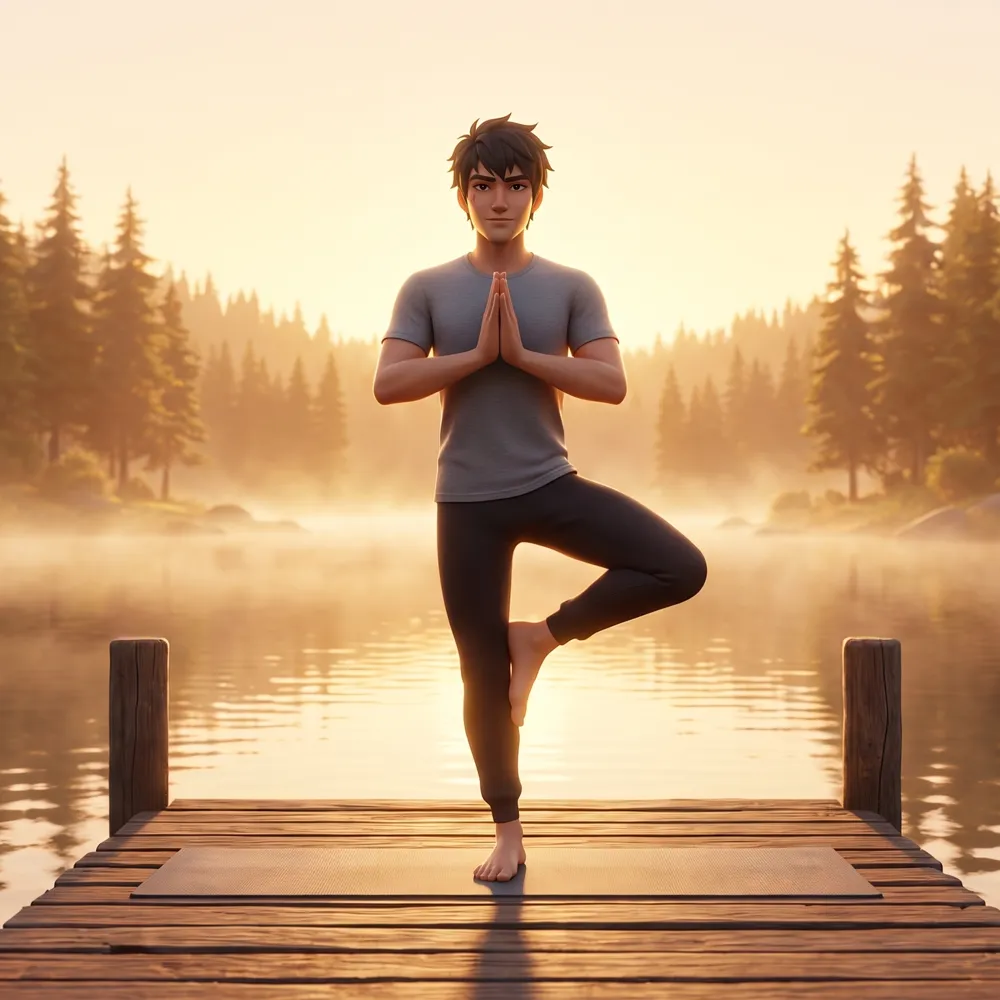
Standing tall and still: Mountain poseStanding tall and still: Mountain pose Generated picture, checked against Cleveland Clinic Health Essentials, Mountain Pose.
Sanskrit: Tadasana, mountain pose (tada, a mountain, the usual reading). Why do it: Cleveland Clinic calls it your body's optimal posture and says it informs all other postures: you stand tall with your feet firmly planted, which reconnects you to your natural posture.
Stand with your feet hip-width apart, toes pointing forward.
Press into all four corners of your feet, then lift and lower your toes to create a firm, grounded base.
Draw your belly in. This tightens all the muscles in your midsection.
Roll your shoulders down and back to open your chest.
Tuck your chin slightly to lengthen the back of your neck.
Reach the crown of your head upward, creating a long spine.
Relax your arms at your sides with palms facing forward.
Breathe deeply and evenly, and hold for 30 to 60 seconds, or longer as you become more comfortable.
These are the Cleveland Clinic steps.
Where you feel it: The belly muscles, which Cleveland Clinic's yoga therapist says support the spine and take the pressure off the lower back. Harvard Health adds the inner arches of the feet, lifting up through the upper inner thighs. Cleveland Clinic's alignment check: hips over knees, knees over ankles, and knees straight but not locked.
Easier, and harder
Easier: sit near the edge of a sturdy chair, feet flat and hip-width apart, and sit up tall from tailbone to crown. Harder: breathe in and raise your arms overhead, palms facing each other or touching, reaching through the fingertips, shoulders down. Deeper, Cleveland Clinic's mild backbend: hands behind your head, gently arch your upper back and lift your chest, head and neck in line with your spine. Go slow, and avoid it with back or balance issues.
What the tradition says
Mountain pose is not among the postures the Hatha Yoga Pradipika describes or the thirty-two that the Gheranda Samhita, another old text, lists, so it is modern. Cleveland Clinic's yoga therapist: "A mountain is steady, solid and unmoving." The Yoga Sutras' one rule for any posture applies: "The posture should be steady and comfortable."
Hold it anywhere: Cleveland Clinic's therapist slips into Mountain pose in line at the grocery store when her lower back acts up. If you are ever unsure where your head, neck or shoulders should be, think about how they feel in Mountain.
Your practice this week
Do:Stand in Mountain pose once a day for 30 to 60 seconds. Feet hip-width apart, weight in all four corners of each foot, belly drawn in, shoulders down and back, chin slightly tucked, crown reaching up, breathing deeply and evenly. In a chair counts: sit near the edge, feet flat, spine tall.
Notice:Notice where your weight sits in your feet. Heels, toes, inside edge or outside edge? It is easy to favour one spot without knowing it. Press the other corners down and feel what changes in your knees, your belly and your breath.
Skip:Skip the backbend version if you have back or balance issues. That is the mild arch of the upper back with the hands behind the head; Cleveland Clinic says to go slow with it and to avoid it in those cases. If you feel unsteady in the plain pose, stand near a wall, or take the chair version.
Quizzes tell your brain this is important.
OmniTaught5 day streakA
Lv 9Lv 101,200 XP to go
Review, timed for just before you would forget.
OmniTaught5 day streakA
Lv 9Lv 101,200 XP to go
Recalling from memory is what makes learning stick, so OmniTaught has you do it three ways: write the key idea in your own words, answer a quiz while the lesson is fresh, and review it just before you would forget.Sources: National Center for Complementary and Integrative Health, National Institutes of Health; Cleveland Clinic, Harvard Health, Johns Hopkins Medicine and the Hospital for Special Surgery; The UK's National Health Service; American Council on Exercise, exercise library; American College of Sports Medicine position stand on exercise; American College of Physicians low back pain guideline; Cochrane reviews; The American Academy of Ophthalmology, the Bone Health and Osteoporosis Foundation and the American College of Obstetricians and Gynecologists, for the cautions; The Yoga Sutras of Patanjali, the Hatha Yoga Pradipika, the Gheranda Samhita and the Bhagavad Gita, in public-domain translations; Peer-reviewed studies in PubMed.
What this course covers
26 lessons, each short enough to finish in one sitting and each ending with questions that make you use what you just read. The last is a timed review of the whole course.
What Yoga IsWhere the word comes from, what the old texts meant by it, what a class is today, and the standing pose every other pose starts from8 min
The Shape of a PracticeHow a session is ordered, how much is enough, the rule that keeps every pose safe, what props are for, how to sit, and the pose you can rest in8 min
Breath FirstBelly breathing and slow breathing, what the trials found, what the old text says of the breath, and the first pose you move with it8 min
Folding and LiftingThe standing forward fold, done from the hips with bent knees, and the halfway lift that pairs with it8 min
The Sun Salutation, First HalfWhat a sun salutation is, how little the old texts say of it, and three of its poses: upward salute, plank, and knees, chest and chin9 min
The Sun Salutation, Second HalfCobra and downward-facing dog, then all twelve steps in a row, slowly, with the breath9 min
Show all 27Show fewer
The WarriorsWarrior I and Warrior II: an old story, two modern poses, and the one rule for the front knee9 min
Triangle and Side AngleTwo wide-stance poses with the lower hand on the shin or a block, and the chair version of each8 min
Five More Standing PosesHigh lunge, Warrior III, half moon, goddess and pyramid: the lunge family grows, and the one-leg balances begin9 min
BalanceTree with a hand on the wall, chair pose, and what the falls trial found: better balance scores, more falls9 min
HipsThe low lunge for the front of the hip, pigeon for the back of it, and the reclined figure-four for any knee that complains9 min
The Backs of the LegsThe seated forward fold with a strap, the restful head-to-knee on a block, and the reclined hand-to-big-toe9 min
TwistsThe seated twist and the reclined twist, and the yogi whose name the seated one carries8 min
The BackBridge, sphinx and the first stage of locust: three gentle backbends, and the rule that keeps your neck safe in bridge9 min
The Middle and the ArmsBoat and side plank: the muscles of the middle, and two small laboratory studies of what they do7 min
Shoulders and NeckEagle arms, cow face arms and thread the needle: three moves for the upper back and shoulders, and what the neck-pain studies found9 min
Rest PosesLegs up the wall, supported bridge and reclined bound angle: three poses where a wall, a block and a cushion do the holding9 min
Deep RelaxationCorpse pose, the pose every class ends on, and yoga nidra, the guided rest done lying in it8 min
Sitting StillHero pose on a block, the cross-legged seats and what lotus is, and a first five minutes of meditation8 min
Om and SoundWhat the Yoga Sutras say Om is, how one slow Om is done, the humming bee breath, what a few small studies found, and bound angle as the seat8 min
What the Studies Say About Anxiety, Mood, Stress and SleepThe strongest recent poolings of trials for the four things people most often come to yoga for, who was studied, what happens against a real comparison, and when to get help instead9 min
The Eight Limbs and the Five RestraintsYoga's oldest map, in which the poses are limb three, and the five restraints that come first, each quoted from the text and read for a modern day; garland squat8 min
The Five ObservancesCleanliness, contentment, discipline, study and letting go of the result, as Patanjali's text teaches them, and the camel in its gentle form8 min
Going Deeper SafelyDancer, dolphin and crow taught step by step, and why wheel, shoulder stand and headstand wait for a teacher9 min
Yoga for Your Body and Your DayFour chair poses and a seated sun salutation, with what changes for a stiff, injured, heavy, older or pregnant body, and for a desk, a sore back and poor sleep7 min
Your PracticeA full sequence from the poses you have learned, a plan you fill in for 10, 20 or 40 minutes, how to choose a class or teacher, and what the tradition says about yoga off the mat8 min
Yoga Timed Review: Set A32 items, 35 minutes, exam mode35 min
Health and wellness, and much more
Start with the health and wellness shelf, then search for anything else. If it is missing, the Topic Genie builds it, and then everyone has it.
Try "I want to help clients with panic", "pass my nursing boards", or "stop being bad at percentages".
Topic Genie
Wish for a topic. Watch it become a course.
Tell the Genie what you want to learn, what you already know, and what it is for. It writes a custom course tailored to you, with lessons, quizzes, and reviews.
One free course for signing up.
Every granted wish goes in the Wish Library, a growing collection of learner-made courses that anyone can add to their app for free. One person's wish becomes everyone's course.
Built by a teacher who became a National Certified Counselor.
OmniTaught is built by Michael C. Shedrick, M.S., PLPC, NCC: a teacher with a master's in educational leadership who became a National Certified Counselor. He built the learning app the research says should exist. Lessons stay short, because attention fades fast. A quiz follows at once, because pulling an idea back out of your own head is what makes it stay, not reading it twice. And review comes just before you would forget, when the effort of remembering does the most good.
Also from the same desk: OmniPsyche Counseling Tools, which preps your next session and not just your notes; OmniPsyche.org, free mental health education with no paywall and no signup; and NOTICE, a free guided meditation app.
Be the one who knows their stuff.
Ten minutes a day. Start with the topic your work depends on, or the one that has bugged you since school.
Choose your hero and watch them level up as you learn.
Seven heroes, twenty-five levels, and a story told a chapter at a time. Advance your hero's quest with every completed lesson and find loot at every new level.
Mage
Warrior
Scholar
Druid
Rogue
Bard
Paladin
Free for a week. Then $9.99 a month.
No card to start.
EVERYTHING INCLUDED
$9.99a month, or $79 a year
Every course in the ever-growing library, every quiz, & your review deck.
One Genie course a month, built on whatever you name. Extra courses are $6.99 each. Add narration to any Genie made course for $9.99.
A free week first, no card needed. Cancel any time from Settings.


 Lv 1Lv 270 XP to go



 Lv 9
Lv 9 Lv 9
Lv 9 Lv 9
Lv 9 Lv 9
Lv 9

 Mage
Mage Warrior
 Druid
Druid Rogue
Rogue Bard
Bard Paladin